

The Demand Case is Settled; the Question is Delivery
Investors have become comfortable with Italian student housing. A recent European investment survey found that approximately three-quarters of investors identified purpose-built student accommodation investment opportunities as a priority for the next one to three years - the highest level of interest among all living-sector asset classes. Today, the sector accounts for roughly 10% to 15% of all living-sector investment across Europe, underscoring growing confidence in its long-term demand and resilience. When the demand case is that widely accepted, it stops being where the money is won or lost.
For a developer and operator, that moves the real question from the market to execution: not whether the demand is there, but whether a building can be delivered and filled to stabilised occupancy on the timetable that the underwriting assumes. Due diligence follows the same shift. It is a test of whether the proposed scheme, its programme and its operating plan can be turned into a full building, and how quickly.
The Return is Made at Exit, On The Ramp to Stabilisation
A student housing scheme return profile is not evaluated on the yield it generates in its first years. Key returns are made at exit, on a stabilised year of income capitalised at the exit cap rate, whether that exit is a sale or a transfer into a yielding vehicle. So, the number that decides the return is not the yield in any single early year; it is how long the building takes to ramp from opening to stabilised occupancy, because every extra year spent reaching it is an extra year of hold, and a longer hold on the same profit is a lower internal rate of return.
Two things set the length of that ramp: when it starts, and how steeply it climbs. The start is a delivery question, because the building has to be open and lettable in time for an intake. The gradient is a market and operating question, because it is set by how fast the rooms fill once the doors are open. Underwriting a scheme means underwriting both, not just the opening date.
Italy’s Imbalance Makes the Ramp Steep
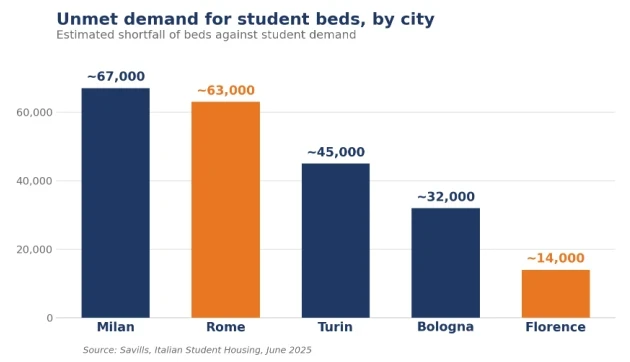
This is where Italy is different, and where the opportunity sits. The Italian student housing market is acutely undersupplied: around 1.9 million university students against roughly 83,000 beds, a national provision rate just above 4% against more than 30% in the United Kingdom, with unmet demand running to roughly 67,000 beds in Milan, 63,000 in Rome and tens of thousands more across the other university cities.
When demand exceeds supply on that scale, a well-located, well-run scheme does not have to work to fill. It ramps to stabilised occupancy quickly, because the tenants are already there. The scarcity that makes the market attractive is the same scarcity that compresses the lease-up, and the lease-up is where the return is won.
A Missed Intake Delays the Fast Ramp, and Not Every City Forgives It
Because the ramp shall be fast, the main risk to it is not a slow fill; it is a delayed start. Italian undergraduate demand concentrates on a single move-in ahead of the autumn academic year, in August and early September. A scheme that is not ready for it does not so much lose the year's rent as lose the start of its ramp, and if the building can only fill meaningfully at that one intake, the ramp waits a full cycle: a year added to the hold, at the point where it costs the most in return.
Whether a delay costs a full cycle or only a few months depends on the city. Rome and Florence are not single-intake cities: both anchor a large and recurring American study-abroad market. The Association of American College and University Programs in Italy represents more than 35,000 students a year, overwhelmingly in Lazio and Tuscany , and a study for the association counted around 30,000 US students in Italy in 2022, a market worth some 900 million euros a year and more than 11,000 jobs. These cohorts arrive on autumn, spring and summer cycles, so a building that misses the main intake can begin its ramp at the next one rather than waiting a year.
Milan is different, and should be underwritten differently. Its market is weighted towards 11-12 month lets, which give better income visibility but fewer chances to start the ramp. Savills records around 193,000 students in Milan and identifies it as Italy's most dynamic city, with roughly a third of the national pipeline . The late-summer intake therefore carries more weight there, though a spring intake still exists: Milan operators such as In-Domus offer shorter second-semester terms alongside standard 6 and 11 month contracts, so even a delayed Milan scheme need not sit empty until the following year.
Contract Structure Helps the Short Ramp
Reaching those extra intakes depends on being able to contract for them, and that has to be designed in, not assumed. Italian university-student leases generally run 6-36 months, and transitory contracts up to 18 months where the temporary need is evidenced, with local agreements affecting the form and sometimes the rent . A 4 or 5 month study-abroad term does not automatically fit a six-month student lease, so the operator has to know, before committing, which lawful form each cohort needs. Summer academic demand is a further intake again, but a separately regulated one: in Lombardy, for instance, hotel and non-hotel uses are governed apart, with their own planning, safety, licensing and tax requirements. A letting plan that assumes these cohorts without confirming the contract and the permitted use is not a plan, it is an aspiration.
Shorter lets can also earn a higher effective monthly rent, since the resident is paying for a furnished, all-inclusive, bookable room, and Savills notes that the services and quality of Italian schemes justify higher rents That is not free income: shorter stays carry marketing, turnover and re-letting costs, so what matters is net effective revenue across the ramp, not headline rent. Used deliberately, though, the shorter cohorts are what let a building climb to stabilised occupancy in one cycle instead of two.
Underwrite the Ramp, Not the Opening Date
The developer's model should therefore be built around time to stabilisation, not a single opening date. It should show, city by city, when the ramp starts under an on-time delivery and under a slip, how fast it climbs given the cohorts a scheme can actually reach, and what a lost cycle does to the exit return, so that the sensitivity that really matters, the length of the hold, is priced rather than assumed. The operating plan should match it: the contract forms for each intake, the marketing lead time, and the point at which a delayed building resets onto the next cycle rather than the next year.
The demand, in other words, is the easier part, and the market has already priced it. What is key to underwrite is whether a scheme can be delivered into its intake and filled to stabilisation quickly, in a market whose scarcity rewards exactly that. That is a fundamental question of delivery, contract design and knowledge of the individual city, which is the work that decides the return once the demand case is taken as read.